

Read-Only & Encryption: How a Secure Magnetic Card Reader Prevents Cloning
2026-06-19Magnetic stripe cards are still everywhere — hotel keycards, employee IDs, loyalty cards, and even some payment cards. But a common myth persists: "Magnetic cards are easy to clone, so any reader is a security risk." This belief is only half true. The real vulnerability isn't the card itself, but how the reader handles the data. A genuine Secure Magnetic Card Reader eliminates the risk of cloning at the hardware level, combining a read-only mechanism with encrypted data output. In this article, we explain the science behind cloning attacks and how a device like the TTCE-RX180 protects your system.
Where Does Magnetic Card Cloning Actually Come From?
Cloning works by capturing the magnetic data from a card's tracks and writing that same data onto a different card. However, the attack usually happens in one of two places:
•During the reading process: An unsecured reader transmits raw magnetic data in plain text over the wire, which can be intercepted.
•Through a write-enabled device: A reader that also writes to magnetic stripes can be misused to reprogram a blank card with stolen data.
•Most people assume all magnetic readers are equally vulnerable. But a true Secure Magnetic Card Reader addresses both vectors by removing the ability to write and by supporting encrypted communication.
Read-Only Hardware: The First Line of Defense
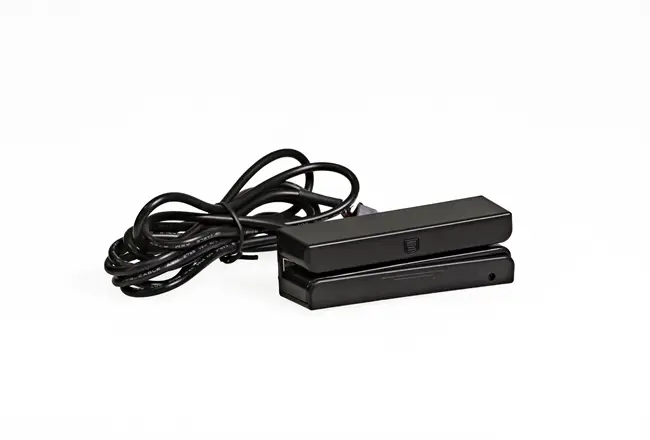
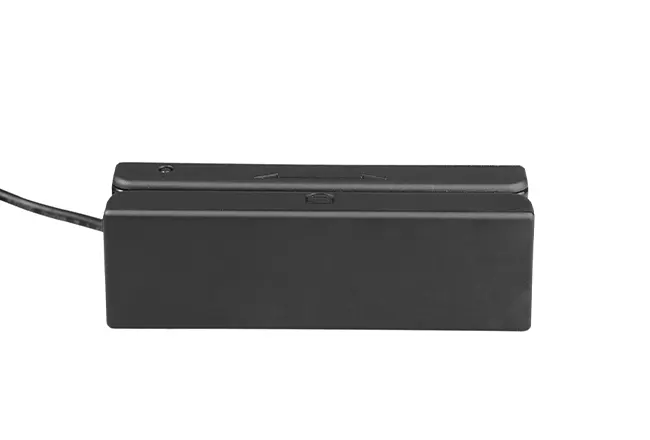
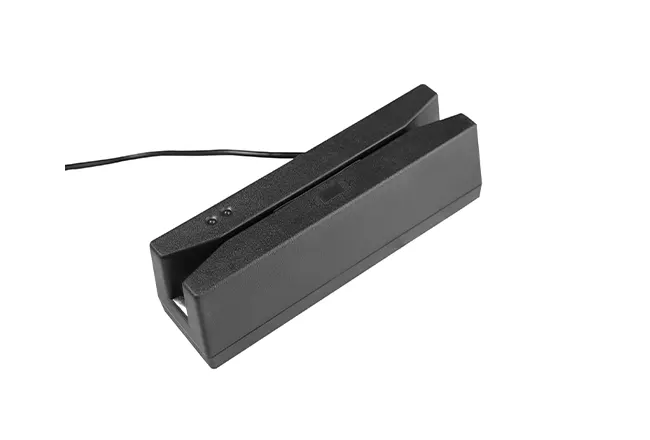
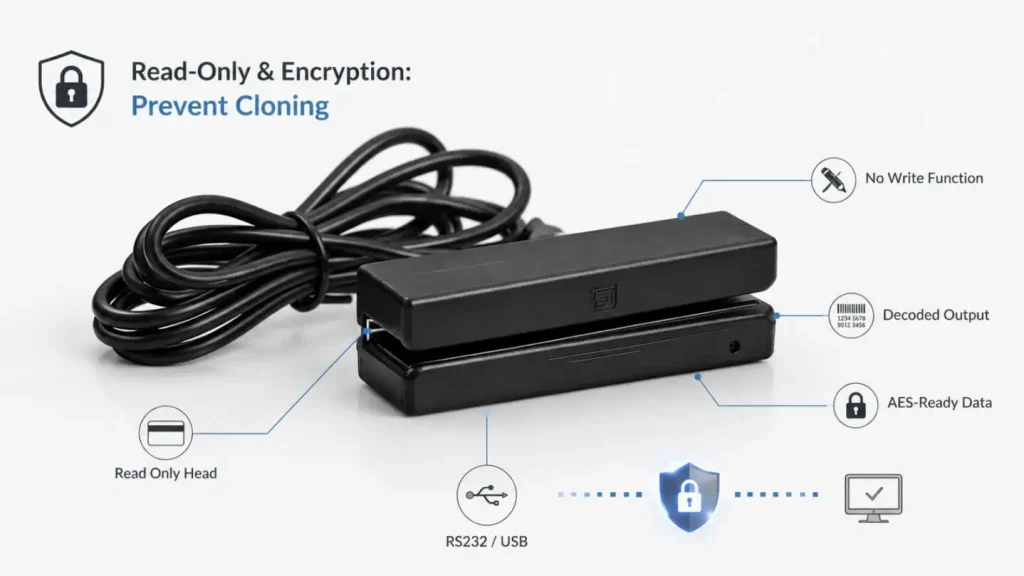
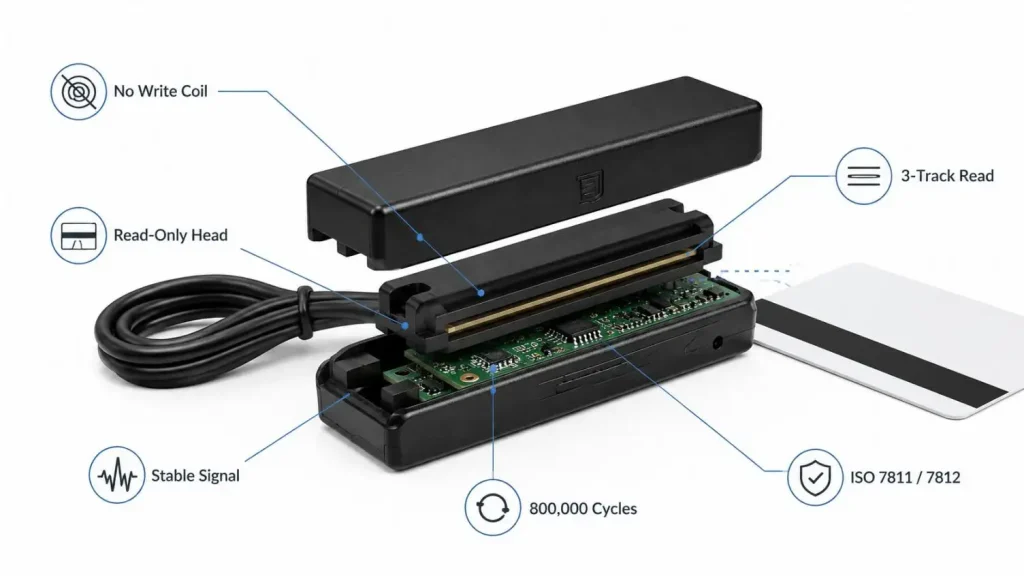
A read-only magnetic head physically cannot alter the data on a card stripe. The TTCE-RX180 is explicitly designed as "Magnetic card read only." This means:
•No write coil is present: The device lacks the electrical components needed to generate a magnetic field strong enough to modify a stripe.
•Impossible to turn into a cloner: Even with malicious software, the hardware cannot write any data back to a card.
•Preserves card integrity: Repeated swipes will never accidentally erase or corrupt the original magnetic information.
In contrast, cheap or multi-purpose readers that support both read and write functions become a cloning tool if compromised. By strictly limiting itself to reading, the Secure Magnetic Card Reader eliminates an entire class of attacks.
How Data Encryption Prevents Eavesdropping Cloning
A read-only device is secure, but what about the data traveling from the reader to the host computer? Without encryption, a hacker can tap the wire (USB or RS232) and capture the raw track data. This is called an eavesdropping attack. The captured data can later be written onto a fake card using a cheap writer. A Secure Magnetic Card Reader prevents this through two methods:
•Output data is already decoded: The TTCE-RX180 converts magnetic signals into digital data inside the reader itself, so raw analog signals never leave the device.
•Encryption-ready interfaces: When paired with an RS232 or custom USB connection, the host system can apply AES or similar encryption before storing or transmitting the card data.
•Keyboard emulation mode: The reader can act as a keyboard, sending data as keystrokes. This bypasses low-level driver interception points commonly used by malware.
The TTCE-RX180 supports both RS232 and USB interfaces, and its output data is fully decoded. This means your system can immediately encrypt the track information (e.g., Track 1, Track 2, or Track 3) before it ever touches application memory.
Why the TTCE-RX180 Embodies the Secure Magnetic Card Reader Standard
The Secure Magnetic Card Reader is not just a marketing term — it is built on technical standards. The TTCE-RX180 complies with ISO 7811/7812, the international specifications for magnetic stripe cards and data layout. Key security-relevant features include:
•Three-track reading capability: Captures all data (Track 1, 2, and 3) — some systems only read Track 2, missing encrypted data on Track 3 used for PIN or offline verification.
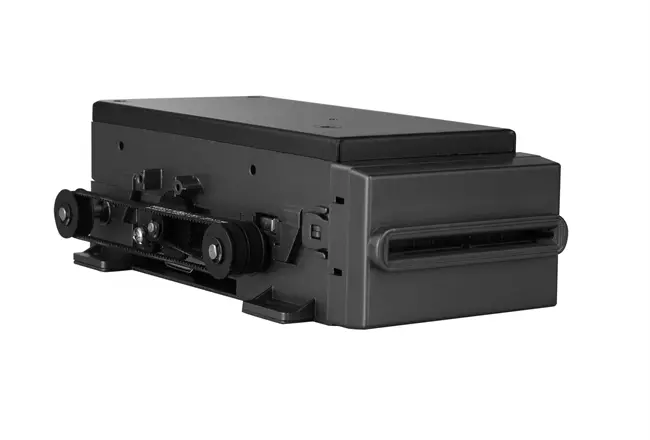
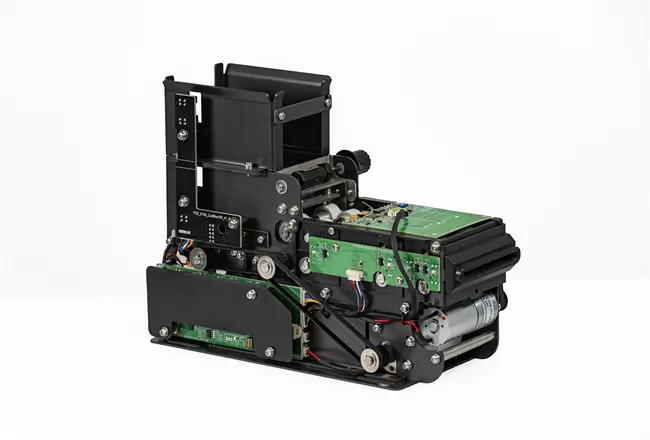
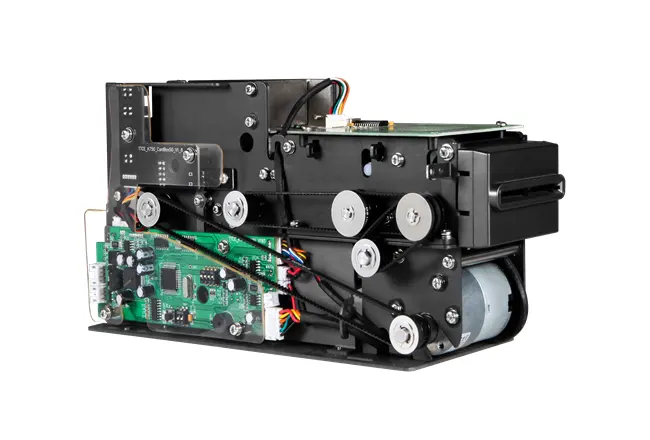
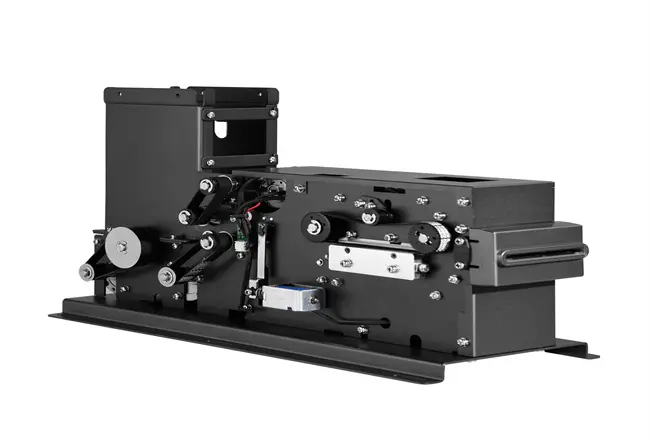
•Compact and lightweight design (approx. 75g): Easily embedded inside self-service kiosks, ATMs, or access control panels without needing to expose internal wiring.
•Customizable interface cable: Integrates with proprietary encryption dongles or serial security-centric focused converters.
•High durability (800,000 cycles): The incomplete and noisy data produced by a worn-out magnetic head can be exploited by skilled attackers. Long life ensures consistent read quality.
Additionally, the TTCE-RX180 operates on DC5V with idle current below 10mA, making it suitable for battery-backed security systems where power stability is critical.
Real-World Applications: Where a Secure Magnetic Card Reader Prevents Cloning
In practice, cloning attacks target specific industries. Using a read-only, encryption-ready reader stops them cold.
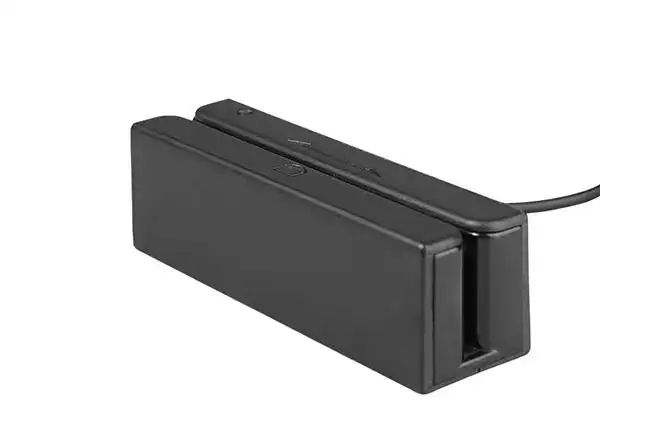
•Banking and ATMs: A Secure Magnetic Card Reader inside an ATM reads only the card data, then immediately encrypts it before sending to the PIN pad module. No plain-text track data ever leaves the reader.
•Access control (offices/hotels): Hotel keycards are often rewritten daily. A read-only reader cannot be abused to encode new keys. The TTCE-RX180 has been deployed in hotel lobby kiosks for this reason.
•Retail POS systems: Swipe readers exposed to customers are prime targets for skimming. A compact, tamper-evident Secure Magnetic Card Reader with RS232 output makes it much harder to tap into the data line.
•Public transportation ticketing: Paper magnetic tickets (ISO15457 compliant) are used in many metro systems. The TTCE-RX180 supports both paper and PVC cards, and its read-only nature ensures ticket vending machines cannot be turned into cloning devices.
Conclusion: Don't Confuse Card Age with Insecurity
Magnetic stripe technology is older than chip cards, but it remains secure when implemented correctly. The true risk comes from poorly designed readers that allow writing and transmit data in plain text. A dedicated Secure Magnetic Card Reader like the TTCE-RX180 solves both problems by:
•Being hardware-limited to read-only operation.
•Outputting decoded data ready for immediate encryption.
•Complying with ISO 7811/7812 for reliable, accurate reads.
•Offering flexible RS232/USB interfaces for secure system integration.
Whether you are upgrading an ATM network, building a self-service kiosk, or deploying a hotel access system, choosing a read-only, encryption-friendly reader is the only way to truly prevent magnetic card cloning. Request a quote for the TTCE-RX180 today and make your next deployment a secure one.
FAQs
Q1: In what way does encryption help with card cloning?
A: Encryption safeguards the data of card tracks once decoded from being captured during transmission to the host computer.
Q2: Does the TTCE-RX180 support all three tracks?
A: Bank and access control functions of the TTCE-RX180 provides data recording on Tracks 1, 2, and 3.
Q3: Which secure integration interfaces are provided?
A: For secure integration, TTCE-RX180 has RS232 and USB (keyboard emulation) interfaces that support encrypted communication.
Q4: Has the TTCE-RX180 product met any of the industry standards?
A: TTCE-RX180 has met standards of ISO 7811/7812 and can work with cards of ISO7810, ISO7813 and ISO15457.
Q5: Is the TTCE-RX180 product configurable?
A: TTCE-RX180 modules are configurable with respect to interface cables, output configuration, and connector type for your system.
